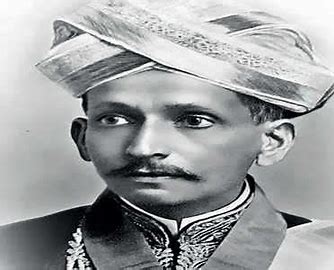
Recently I chanced to read on the net, Mokshagundam Visvesvaraya’s (MV) book, “Reconstructing India” , written almost a century ago, and the little that I read persuaded me to buy it.
If one did not know the source one would think its some contemporary commentator. This reflects the sad story of the lack of our development and MVs clear eyed perspicacity.
“The public activities of the country have hitherto yielded scanty results, because they have not had a reasoned scheme of national life behind them. State policies to be successful, must have for their sole aim the good of the people, and must be precise and adapted to their understanding, tastes and means”.
And
“If the utilisation of India’s man power and material resources is placed in the forefront of national aims, if the people’s general and technical knowledge is developed, if private initiative is stimulated, if all the inventions and discoveries are applied to increase production, if foreign experience is adapted to Indian conditions and fully utilised and useful foreign institutions readily adopted, if in short, all the improvements necessary and possible are introduced, the development of India, politically, economically and socially, will proceed at a pace which may be one of the outstanding features of the coming generation.”
He goes on to say
“The immediate future will put all persons and institutions to a severe test. The forethought and vigour with which Indians apply themselves to their new task, their capacity for joint action, their ability to maintain harmonious relations between all races and communities, and the cooperation which they will be able to secure between themselves and Government agencies will determine the pace of their progress.”
These 3 paras are enough to lay out a direction for us even today. Just re-reading these paras reveals our fault lines. What is the aim of state policy? Is private initiative stimulated ? Joint action is an oxymoron for us, may be more today than even during his times. It is the Achilles heel of our civilisation.
Obviously, there is much in it that is dated but a lot more that resonates. The book led me to his speeches, available online. They are even more pithy. I am in the process of excerpting from them. There are 400 pages of them so it will take some time.
But there are 3 things running through the book and the speeches. Clear as crystal.
- Education, education, education (in its real sense)
- Village development
- Industrial development
And who would do it? People of competence, character, a sense of responsibility and diligence. Who are rare in our society, which is full of slackers. His words not mine.
What is note worthy in his speeches are both his grasp of facts and a forward looking orientation which is manifested in plans and their outcomes and not mere verbiage.
For example he is talking of building culverts in the 1920s and thinking of the development of Ford Motor company and can envision that tractors would not be too far in coming, so the culverts should be able to take their load. It’s a small thing but we are struggling in 2021 AD in Nimsada village because the pathway over the barrage was not made wide enough for a bullock cart, and can’t take the load of a tractor.
His training in Civil Engineering gave him exposure to urban and rural infrastructure, including irrigation. And his role as Dewan made him think of education, industrial development and social questions.
The list of enterprises he fostered are a legion. Besides the Cauvery dam, Bhadravati Steel Works, Mysore Sandal Soap works, Bank of Mysore. Any of them, would have been enough of a lifetime’s achievement!
The speeches are at many occasions, largely routine, but at each one of them he brings out some aspect that is of broader relevance. Be it a school for the blind, inauguration of a pumping station etc. Equally noteworthy are his organising annual conferences for Engineers and on the Economy.
At various points he says:-
“While the West think and act in conformity with economic necessities, we expect to prosper without acquiring the scientific precision, the inventive faculty, the thoroughness, the discipline and restraints of modern civilization.”
AND
“We are too much accustomed to soft conditions. The number of working hours is fewer here than in Europe. Official employment is sought for because once a man gets into service, whether efficient or weak, wise or imprudent, he is practically sure of a living for the rest of his life.
Closely associated with slackness is lack of initiative, the inclination to look for instructions from the top at every step. No original investigation will be possible unless every one thinks for himself. Unless people consider slackness a disgrace, there is no hope of improvement”. AMEN.
Negative or honest? And as Confucius says, “Man on the make, many complaints”.
Further
“We are accustomed to one man rule. Among us, co-operative effort is utterly lacking. Our associations and committees, somehow, do not thrive. In such bodies, the faculty of disputation is unduly developed; that of decision and action is feeble or lacking”.
But he was crystal clear what delivered outcomes.
“Whether the work in the districts is to be maintained well or ill, whether the management is economical or the reverse, depends largely on the efficiency of the staff and particularly on the personal energy and foresight of the head of the district”.
For head of district, one can put anyone with responsibility. By diluting the importance of efficiency and over emphasising equity, we have damned outcomes.
And the way forward for personal advancement.
“I would therefore say to the young engineer —Study the business methods of our European fellow engineers, cultivate system, give strict attention to detail, avoid both lack of confidence and over-confidence, and rely on yourself and your work for your material advancement. Remember character is more important than cleverness.
Success depends very largely on your own capacity, integrity and keenness for work. If you get into the habit of giving your whole hearted attention to the work entrusted to you, and if you are able to concentrate and absorb yourself in it, you may be sure others will not forget you.”
And for the time being finally-
“If the public ask me what the Government is going to accomplish during my term of office, I will only say it will depend on what the people themselves may help to build up. Government will be what the people make it; it cannot be much in advance of the capacity of the people”.
In MV we have an archetype of a person, from whom we can learn a lot. Kurien has left an imprint that is not yet washed off. MV’s sweep was broader but little remains of his legacy. Maybe only the irrigation systems. But his approach still has life.
And at the end of his life, he chose to return to Mokshagundam, rather than live in Mysore or Bangalore both of which he had done so much to develop. It is these little touches that truly define a man.
I will come back to the sub-themes he pursues and their continuing relevance, because they are still what is required and it is what we should be engaged in, in our own little ways. Till then, something to chew on.
 Sanjayuvach